 English
  العربية
  Nederlands
  Français
  Deutsch
  Italiano
  Português
  Русский
  Español
Several types of metal exist, but only a handful have specific properties that support sheet metal bending. Ductility, malleability, and stretchability are some of these properties. All metal parts are engineered from these metals. This article explores various aspects of these metals to help you understand them better.
The Common Sheet Metal Bending Materials
Copper, bronze, stainless steel, steel, and aluminum are common metals used for sheet metal bending. Each metal has different properties, but they all share similar properties that support their bendability.
1.Aluminum
Most manufacturers used aluminum as the primary metal in this fabrication process. This metal’s features, such as low density, support its use across several industries. Aluminum is also the most malleable metal, making it easy to shape into intricate bends.
Aluminum properties
Some of the major properties of aluminum include;
- High corrosion resistance
- High thermal conductivity
- High strength-to-weight ratio
- Low toxicity
- Excellent ductility and malleability
Pros and cons of aluminum
| Advantages of aluminum | Disadvantages of aluminum |
| Lightweight material | Lower strength |
| Available in large quantities | Not suitable for certain applications |
| Ability to be recycled | Prone to denting |
| Low cost | |
| Highly durable |
Industrial applications
Aluminum is the most common metal used in almost all industries. Most of the uses revolve around automatic and aerospace industries to make parts and components. Other applications include construction, kitchenware, and transport industries.
2.Copper
Copper is another common sheet metal bending material that exists in large quantities. Like aluminum, copper exhibits properties such as high ductility and malleability, making it reliable for bending processes. It also has a characteristic reddish-brown color that makes it useful in specific applications.
Properties of copper
Copper has several properties and characteristics, including;
- Good corrosion resistance
- Excellent electrical and heat conductivity
- Excellent machinability
- Highly ductile and malleable
Pros and cons of copper
| Advantages of copper | Disadvantages of Copper |
| Strong and durable | Expensive than aluminum |
| It’s toxins-free | Prone to oxidation and tanning |
| It’s recyclable | Dense than aluminum |
| Cannot tolerate high-stress |
Industrial applications

Due to its electrical conductivity, copper is highly used in electrical appliances. It is used to make heat exchangers, transformers, radiators, etc. Copper can be used to create a part or an entire component.
3.Bronze
Bronze is an alloy of copper and tin. The combination of the properties of these two metals gives bronze a unique set of properties. For instance, it has superior resistance to wear compared to other metals. This makes it an excellent choice for sheet metal bending materials for various applications.
Properties of bronze
When highlighting the properties of bronze, the properties of the metals that make up bronze are not singled out.
- Fatigue resistance
- Low friction
- High melting point
- High tensile strength
- Resistant to corrosion
Pros and cons of bronze
| Advantages of bronze | Disadvantages of bronze |
| Sustainable | Expensive |
| Good surface finish | Takes time to produce |
| Anti-microbial | Limited machinability |
| Weather resistant |
Industrial applications
Metals that exhibit properties such as low metal-to-metal friction and resistance to fatigue, such as bronze, are used in environments with harsh conditions. Bronze is highly used in marine environments.
4.Stainless Steel
Stainless steel is an alloy of iron and carbon engineered for specific applications. Unlike other types of metals, it is widely known for its ability to resist rust, making it suitable for several applications, particularly in wet conditions.
Properties of Stainless Steel
Some of the properties of this metal alloy include;
- Corrosion resistance
- Poor thermal conductivity
- Resistant to surface deformation
- High tensile strength
- Low-maintenance
- Non-magnetic
Pros and cons of Stainless Steel
| Advantages of Stainless Steel | Disadvantages of Stainless Steel |
| Low-cost material | Difficult to weld |
| Versatile applications | Cannot resist some chemicals |
| Easy to form and fabricate | Requires special tools |
| Highly durable |
Industrial applications
Some of the common industries that use stainless steel include food and beverage. It is used in this industry due to its resistance to corrosion and rust. Stainless steel is also used in the medical, automotive, and construction industries.
5.Steel
Steel is also an alloy of iron and carbon. It has better properties than stainless steel, which makes it more reliable for sheet metal bending. Still, there are areas where stainless steel outshines steel.
Properties of Steel
The following are the common properties of steel.
- High impact strength
- Magnetic
- Good malleability
- High tensile strength
- Non-combustible
Pros and cons of Steel
| Advantages of Steel | Disadvantages of Steel |
| Can undergo cold-forming | Prone to rusting |
| Has many grades | Denser than stainless steel |
| Its properties can be improved | Not easy to bend |
| Highly sustainable |
Industrial applications
Steel is used in construction, manufacturing, transportation, and medicine. These industries require durable metals with properties exhibited by steel. It is used to make parts, tools, and gear used in these industries.
6.Titanium
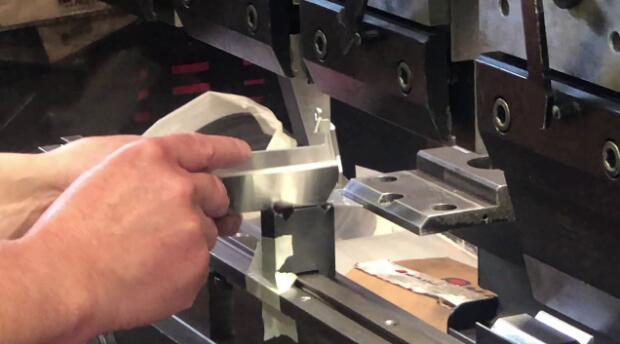
To get titanium metal, several metals are alloyed. Iron, molybdenum, nickel, and aluminum are the most common metals used to make titanium. It is a lightweight but quite versatile metal alloy used as a sheet metal bending material.
Properties of Titanium
Here are some common properties of titanium;
- High strength-to-weight ratio
- Strong metal
- Low density
- Poor heat and electricity conductor
- Prone to oxidation
Pros and cons of Titanium
| Advantages of Titanium | Disadvantages of Titanium |
| Excellent biocompatibility | Quite expensive |
| Good mechanical properties | Not suitable in high-temp environments |
| Low toxicity | Limited machinability |
Industrial applications
Medicine is among the major consumers of titanium. This metal is used in medical fields to manufacture bio parts such as orthopedic and dental inserts. It is used in these industries because of its low toxicity and high biocompatibility.
Conclusion
Sheet metal bending requires materials that exhibit specific mechanical and chemical properties. Primarily, the metals discussed in this article are used because they are naturally malleable and ductile. Contact us to learn more about our sheet metal bending processes.