 English
 العربية
 Nederlands
 Français
 Deutsch
 Italiano
 Português
 Русский
 Español

A CNC press brake back gauge is a key positioning system that helps place sheet metal accurately before each bending operation. It determines where the workpiece is positioned relative to the tooling. And consistent positioning is essential for maintaining flange dimensions and repeatability.
But how exactly does the press brake back gauge system affect CNC bending accuracy?
In fact, modern CNC press brake back gauges use multiple positioning axes, precision drive components, CNC control, and calibrated gauge fingers to reduce positioning variations. Depending on the machine configuration, a back gauge can also support more complex parts and reduce manual setup work.
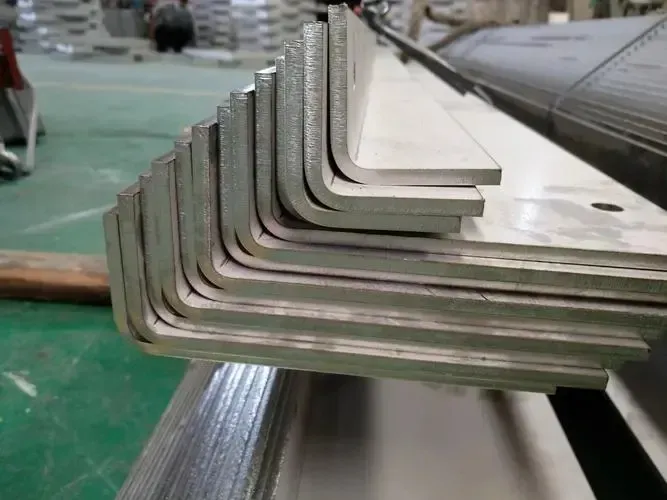
How Does a CNC Press Brake Back Gauge Improve Bending Accuracy?
1. Multi-Axis Precision Positioning
Basic back gauge may use an X axis to move the gauge fingers forward and backward, controlling the position of the sheet before bending. More advanced back gauge add R, Z1, Z2, X1, or X2 axes to handle different workpiece geometries.
- R axis provides vertical positioning
- Z1 and Z2 allow the gauge fingers to move laterally
Advanced multi-axis systems can independently position different gauge fingers, which is useful for asymmetrical parts, different flange dimensions, and more complex bending sequences.
The right combination allows the CNC press brake to position each workpiece according to the programmed bending sequence with less manual adjustment.
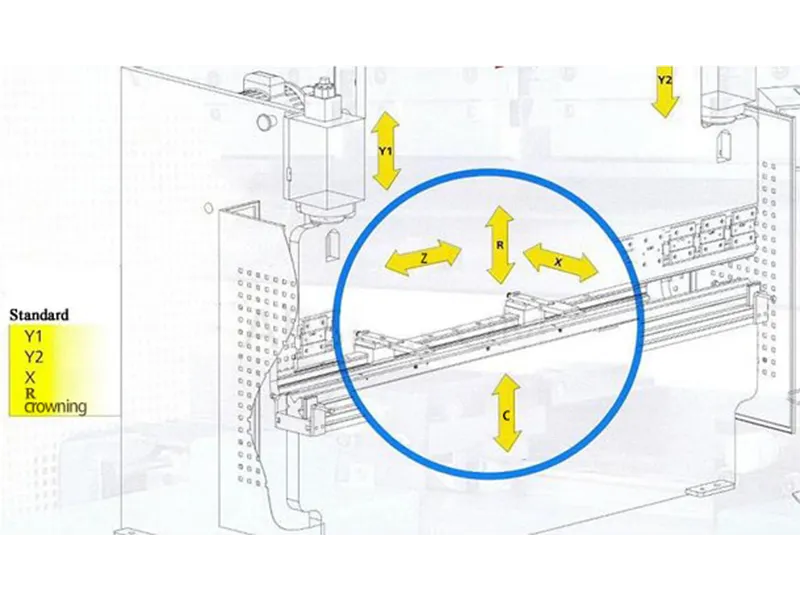
2. High-Precision Drive Systems
Positioning accuracy also depends on how the back gauge moves. Modern systems commonly use servo-driven axes together with components such as ball screws, linear guides, precision racks, or belts, depending on the axis and machine design.
These components help provide controlled and repeatable movement. When the gauge fingers consistently return to their programmed positions, the sheet can be positioned more consistently from one bending operation to the next.
This is very important for production involving repeated parts, because small positioning variations can accumulate into noticeable differences in flange dimensions.
3. Dynamic Compensation and Auto-Calibration
A CNC back gauge must maintain its positioning accuracy during regular operation. Calibration and compensation functions can help account for positioning deviations and maintain consistent movement.
Differ from the compensation systems used to control ram or worktable deflection. Back gauge compensation primarily concerns positioning, while systems such as CNC crowning address other aspects of the bending process.
A properly calibrated positioning system gives the CNC controller a reliable reference for moving the gauge fingers to the required position.
4. Sensor-Integrated Back Gauge Fingers
Depending on the machine configuration, sensors and position feedback can further improve the control of back gauge movement and workpiece positioning.
The gauge fingers act as physical reference points for the sheet. When the workpiece reaches the programmed position, the CNC system can proceed with the bending sequence according to the programmed parameters.
Sensor and feedback technologies are especially valuable in automated or highly repeatable production because they can reduce uncertainty in the positioning process.
5. Eliminating Human Positioning Errors
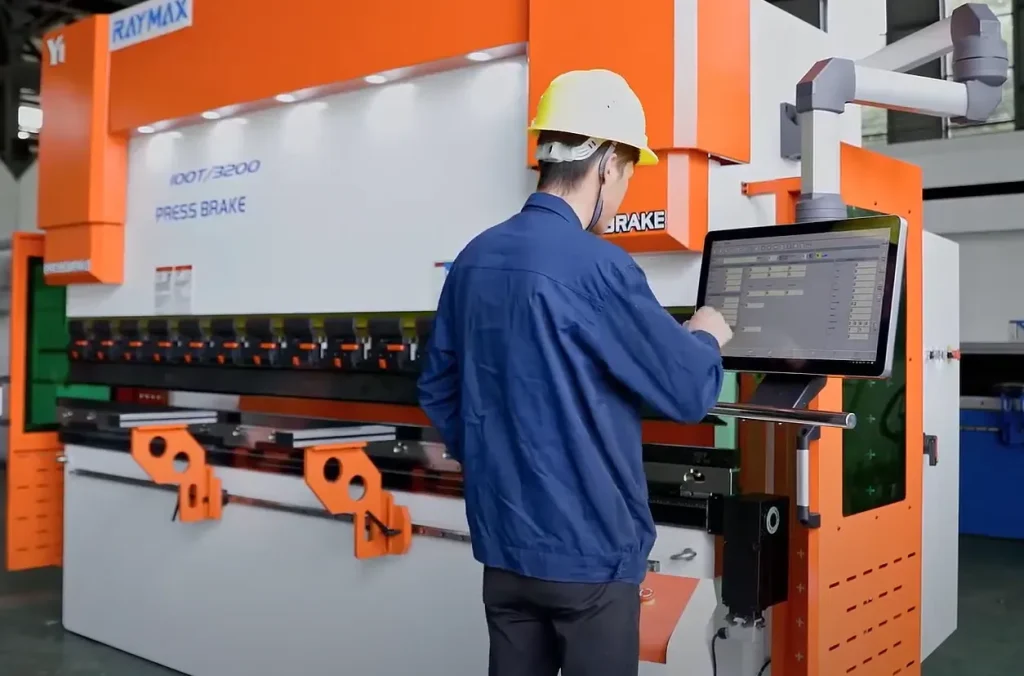
Manual positioning requires operators to measure, align, adjust, and repeatedly check the workpiece. Even with experienced operators, repeated manual positioning can introduce variations between parts.
A CNC press brake back gauge replaces much of this repeated positioning work with programmed movement. Once the required position is programmed, the gauge can automatically move to the corresponding location for each bending step.
There are still need for operator judgment. But it reduces unnecessary manual measurement and adjustment, making production more consistent and reducing dependence on manual positioning.
6. Springback and Slippage Considerations
Material springback is mainly related to
- material properties
- thickness
- bending method
- tooling,
- bending parameters
Therefore, a back gauge cannot eliminate springback by itself.
Accurate workpiece positioning is important when a CNC press brake applies programmed bending and compensation values. If the sheet is positioned incorrectly or moves during the operation, the resulting flange dimensions can differ even when the programmed bending parameters remain unchanged.
Stable back gauge positioning therefore works together with CNC angle control, tooling, and springback compensation to achieve more consistent finished parts.
2-Axis vs. 4-Axis vs. 6-Axis CNC Back Gauge
The appropriate back gauge configuration depends on the parts being produced rather than simply choosing the highest number of axes.
| Configuration | Typical Axes | Suitable For |
| 2-Axis | X + R | Standard parts and relatively simple bending operations |
| 4-Axis | X + R + Z1 + Z2 | More varied part geometries and independent lateral positioning |
| 6-Axis | X1 + X2 + R1 + R2 + Z1 + Z2 | Complex, asymmetrical, or high-mix production |
Similar 2-, 4-, and 6-axis configurations are commonly used in modern CNC press brake back gauge systems.
Generally, “more axes = greater positioning flexibility” but “more axes ≠ higher bending accuracy.”
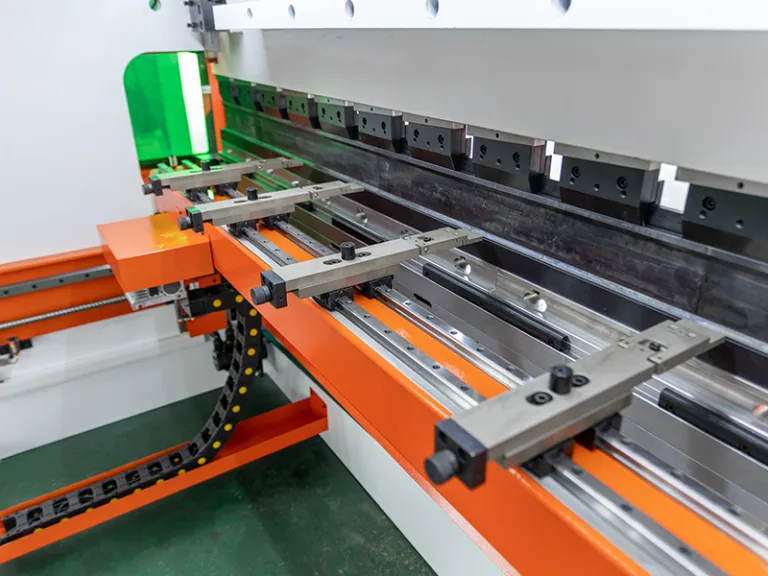


How to Choose the Right CNC Press Brake Back Gauge?
When selecting a back gauge, manufacturers should consider:
- Part dimensions and geometry
- Number of bends per workpiece
- Flange dimensions
- Tooling configuration
- Required dimensional repeatability
- Production volume
- High-mix or repetitive production
- Required level of automation
For simple and repetitive parts, a basic configuration may provide sufficient positioning capability. More complex parts may justify additional axes to reduce manual adjustment and simplify the bending sequence.
The back gauge should also be considered together with the CNC controller, tooling, machine size, and overall bending requirements. RAYMAX, for example, offers CNC press brakes in configurations from 2 to 11 axes and provides Back Gauge Modification as one of its press brake upgrade options. Its product range includes 3–4 axis and 6-axis CNC press brakes as well as higher-axis configurations.
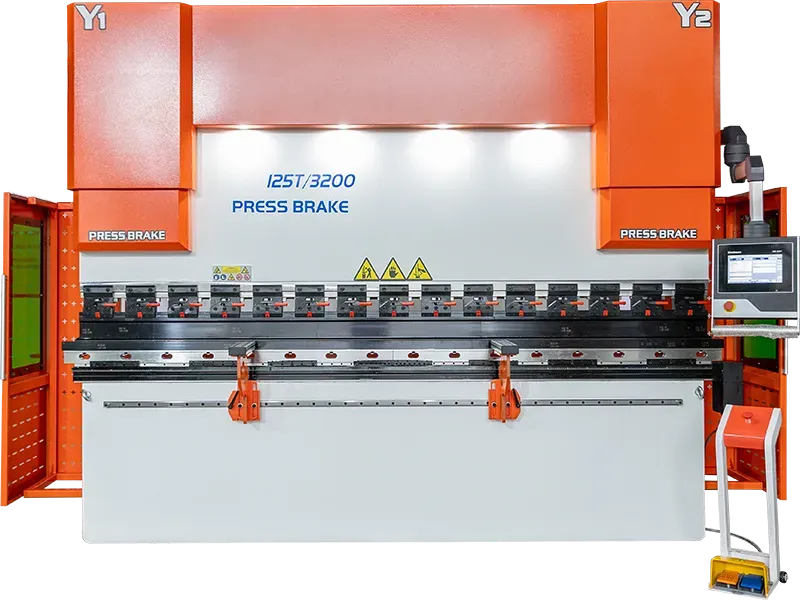

Choose the Right CNC Press Brake and Back Gauge
A CNC press brake back gauge improves bending accuracy primarily by making sheet positioning more precise, repeatable, and consistent.
However, back gauge performance is only one part of overall CNC bending accuracy. Machine rigidity, tooling, material properties, bending parameters, angle control, and springback must also be considered.
RAYMAX provides CNC press brake solutions with different axis configurations and back gauge options to match different workpiece geometries and production requirements. Whether you need a basic configuration for repetitive bending or a multi-axis CNC system for more complex parts, the right configuration can help improve positioning consistency while reducing unnecessary setup work.
For help selecting a suitable CNC press brake and back gauge configuration, share your material, thickness, workpiece dimensions, bending length, and typical bending operations with the RAYMAX team for a suitable machine recommendation.