 English
 العربية
 Nederlands
 Français
 Deutsch
 Italiano
 Português
 Русский
 Español

Two CNC press brake machines may both be rated at 100 tons with a 3200 mm bending length, yet their actual performance and standard configurations can differ considerably. For a small or medium-sized sheet metal workshop, these differences affect bending accuracy, setup time, maintenance, and long-term operating costs.
Before comparing prices, buyers should examine the complete specifications of CNC press brake machines, including the controller, hydraulic system, back gauge, frame, bending capacity, and factory testing. The following checks help identify missing configurations and select equipment suited to actual production requirements.
1. CNC Controller: Check the Model and Functions
The CNC controller determines how operators program bending sequences, control machine axes, and manage tooling data.
Common systems include Delem, ESA, and Cybelec. However, functions vary between models, even within the same brand.
When comparing controllers, verify:
- Exact controller model and software version.
- Graphical programming and bend sequence calculation.
- Number of supported and installed CNC axes.
- Tool libraries, angle correction, and offline programming options.
A workshop producing simple brackets may work efficiently with a basic graphical controller. Manufacturers handling complex enclosures or frequent product changes may benefit from more advanced programming functions.
RAYMAX lists several CNC control system options with different programming and axis-control capabilities.
Ask suppliers to demonstrate programming one of your actual parts. This helps determine whether the proposed controller matches your production needs.
2. Hydraulic System: Verify the Actual Components
In a hydraulic CNC press brake, the pump, valve assembly, cylinders, and control system work together to generate and regulate bending force.
Two machines with identical rated tonnage may use different hydraulic components.
| Component | What buyers should check |
| Hydraulic pump | Manufacturer, model, rated pressure |
| Proportional valves | Brand, type, control arrangement |
| Hydraulic cylinders | Seals, construction, pressure rating |
| Hydraulic power unit | Motor, filtration, cooling |
| Y1/Y2 synchronization | Feedback and control method |


For electro-hydraulic synchronized machines, confirm that both ram axes are controlled through the specified feedback system.
Request the hydraulic schematic and component list. If the quotation mentions a premium component brand, the exact model should appear in the technical agreement.
3. Back Gauge: Compare Axes and Positioning Accuracy
The back gauge positions the workpiece before bending. Its configuration affects flange dimensions and the amount of manual adjustment required between jobs.
Typical configurations include X for front-to-back movement, R for vertical positioning, and Z1/Z2 for lateral finger movement. Y1/Y2 control the ram rather than the back gauge.

A workshop processing straightforward parts may not require independently controlled gauge fingers. More complex components can benefit from additional axes.
RAYMAX provides different press brake back gauge configurations, including X/R and multi-axis arrangements.
Buyers should also distinguish between:
Positioning accuracy: The difference between the commanded and actual position.
Repeatability: The consistency of returning to the same position over repeated movements.
Ask for both specifications, their measurement conditions, and the test results. Back gauge repeatability alone cannot guarantee finished-part accuracy because material variation, tooling, and springback also affect bending results.
4. Frame Structure and Crowning: Check Performance Under Load
Frame stiffness influences how a press brake deforms during bending. Welding quality, structural design, machining, and alignment all affect machine performance.
Do not judge structural quality by frame plate thickness alone.
Long workpieces require particular attention to crowning. Under load, the ram and bed deflect, potentially producing different bending angles at the center and ends of a sheet.
Mechanical or CNC-controlled crowning can compensate for part of this deformation.
Ask the manufacturer to bend a representative long workpiece and measure angles at several positions. A documented test provides more useful evidence than general claims about frame rigidity.
5. Tonnage: Match Capacity to Actual Workpieces
A 100-ton CNC press brake does not have one fixed maximum bending thickness.
Required force depends on material tensile strength, sheet thickness, bending length, V-die opening, and tooling geometry.
For example, bending a 3 mm mild steel sheet over 2000 mm requires different force from bending a thicker stainless steel sheet over the same length.
Before requesting a final configuration, provide:
- Material grades and thickness range.
- Maximum bending length.
- Required bend radius and angle.
- Part drawings and production volume.
Ask for a bending-force calculation and verify tooling load limits, allowable load distribution, and usable working length.
Excess capacity increases investment without necessarily improving productivity. Insufficient capacity can restrict production and create unsafe operating conditions.
6. Accuracy and Factory Testing: Request Measurable Results
Machine specifications should clearly distinguish ram repeatability, back gauge accuracy, and finished bending-angle tolerance.
These figures measure different aspects of performance and should not be treated as interchangeable.
Before shipment, agree on a factory acceptance test (FAT) covering:
- Y1/Y2 positioning and repeatability.
- Back gauge positioning measurements.
- Hydraulic and electrical operation.
- Repeated bending of sample workpieces.
- Angle consistency across longer parts.
- Applicable safety-device checks.
Define the test material, tooling, measurement method, and acceptance tolerances in advance.


For overseas purchases, also verify applicable safety and conformity documentation. Factory acceptance results do not replace required regulatory compliance.
7. After-Sales Service: Evaluate Long-Term Costs
A lower purchase price may offer little advantage if critical spare parts are unavailable or technical support is delayed.
Confirm warranty coverage, replacement-part lead times, operator training, installation arrangements, and remote troubleshooting capabilities.
Request electrical drawings, hydraulic schematics, maintenance manuals, and recommended service intervals.
For workshops without dedicated maintenance engineers, clear technical documentation and accessible support can be particularly valuable.
8. Compare Quotations Using the Same Checklist
Before choosing between suppliers, confirm that their quotations cover equivalent equipment.
| Comparison item | Required confirmation |
| Machine capacity | Tonnage, working length, load limits |
| CNC controller | Exact model and software functions |
| Back gauge | Axes, travel, accuracy specifications |
| Frame and crowning | Construction and compensation method |
| Tooling | Included punches and dies |
| Factory testing | FAT criteria and inspection records |
| Service | Warranty, training, spare parts |
For example, RAYMAX’s RX-S Series 6-axis CNC press brake provides a published configuration that buyers can use as a reference when discussing controller and back gauge options. The final supplied configuration should always be confirmed in the quotation.
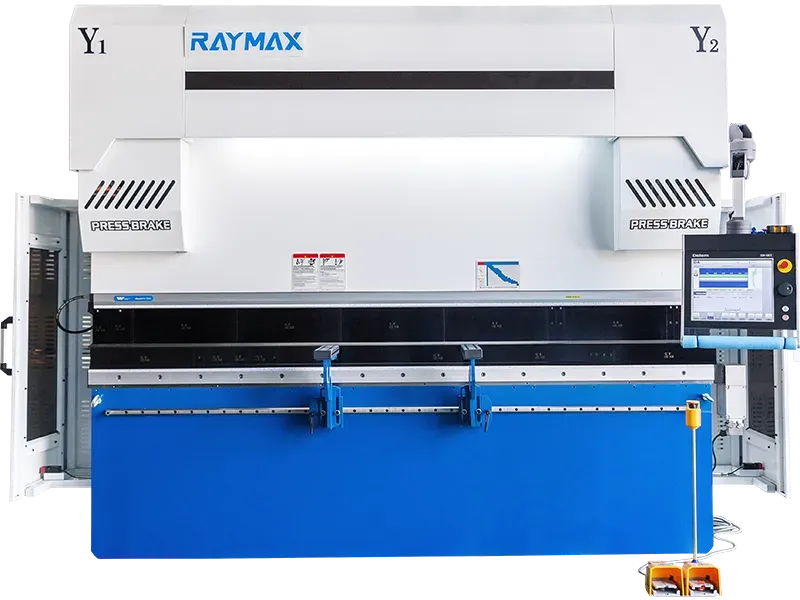
The best purchasing value comes from a machine that meets your production requirements with manageable operating and maintenance costs.
Request a CNC Press Brake Configuration
Comparing CNC press brake machines becomes easier when manufacturers evaluate the same workpieces and production requirements.
Explore the RAYMAX CNC press brake range and contact the team with your material grades, thickness range, maximum bending length, and part drawings. Request a recommended configuration, technical specifications, and an itemized quotation before making your purchasing decision.