 Français
  English
  العربية
  Nederlands
  Deutsch
  Italiano
  Português
  Русский
  Español
In the world of metal bending and fabrication, the debate between NC vs CNC press brake machines continues to shape investment decisions for manufacturers. While both machines serve the same fundamental purpose—bending sheet metal into desired shapes—they differ significantly in terms of technology, performance, automation, and efficiency. Understanding these differences is essential for selecting the right machine for your production needs.
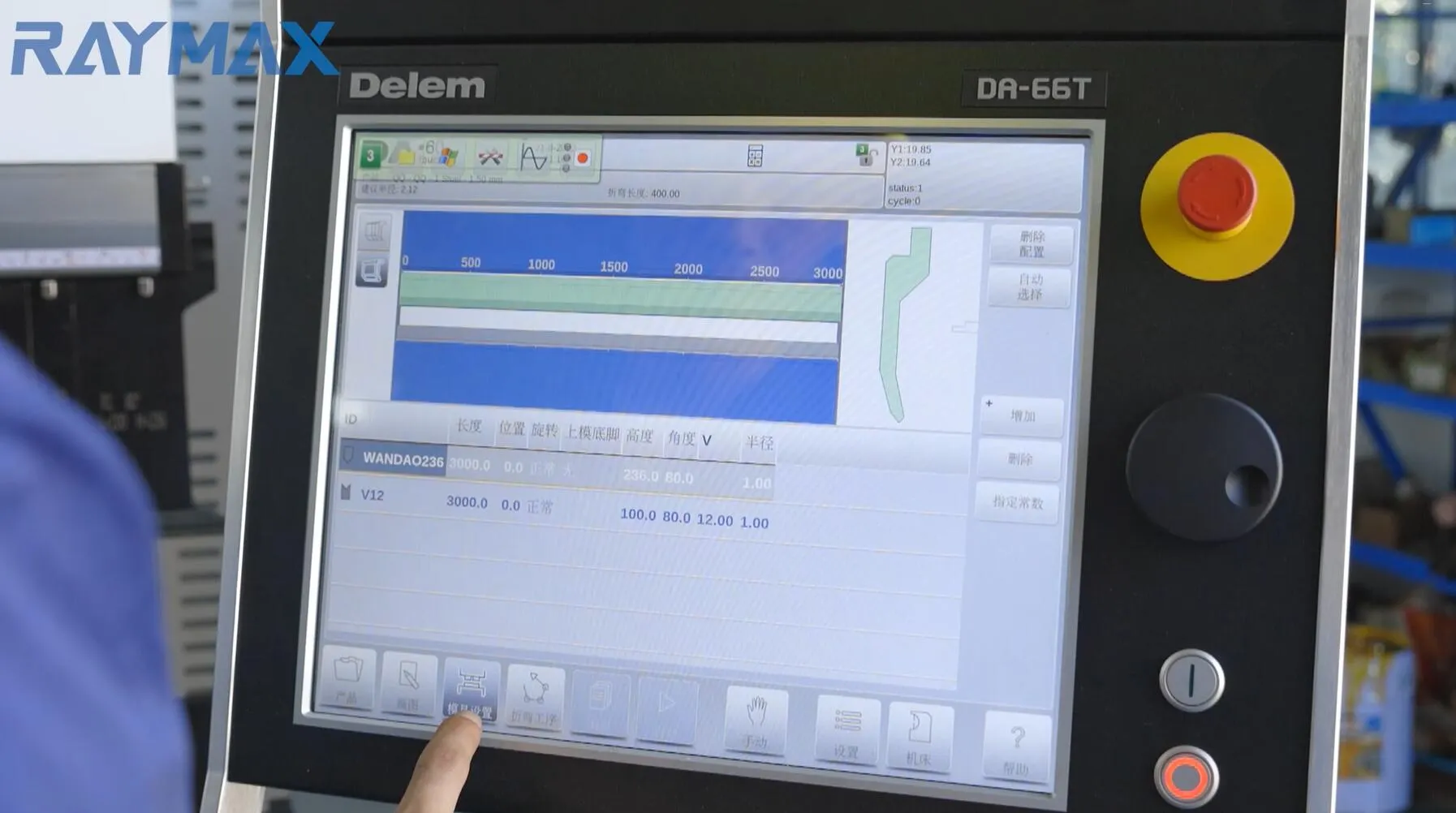
Contrôleur de presse plieuse CNC
In this article, we will explore the key differences between NC and CNC press brakes and help you determine which option best suits your manufacturing operations.
What is an NC Press Brake?
NC (Numerical Control) press brakes use a basic control system to manage bending operations. These machines typically allow operators to set back gauge positions and ram stroke manually through a control panel, often using systems like E21 or similar two-axis controllers.
NC press brakes are generally more affordable, easier to operate, and ideal for small-scale or straightforward bending jobs. For example, the RX-N Series NC Press Brake with E21 2-Axis by Raymax is designed for reliable performance and intuitive control, perfect for entry-level fabricators or workshops with lower production volumes.

Key Features of NC Press Brakes:
- 2-axis control (typically Y and X axes)
- Manual or semi-automatic programming
- Cost-effective
- Suitable for repetitive, simple bends
- Slower setup and less flexible
What is a CNC Press Brake?
On the other hand, CNC (Computer Numerical Control) press brakes offer a high level of automation, accuracy, and repeatability. These machines are equipped with multi-axis controllers (ranging from 3 to 8 axes or more), and can store complex programs for different bending sequences and material types.
CNC press brakes are ideal for high-volume, high-precision, and complex bending applications. Raymax offers a wide range of CNC press brakes such as:
- Presse plieuse CNC série RX-S 3-4 axes
- Presse plieuse CNC série RX-S 6 axes
- Presse plieuse CNC Hybrid Plus série RX-H 8 axes
- RX-E Series Synchro-Electric CNC Press Brake 4/6/8 Axis
These models allow fabricators to increase productivity while ensuring consistent quality across batches.

Key Features of CNC Press Brakes:
- Multi-axis control for complex bends (Y1, Y2, X, R, Z1, Z2, etc.)
- Programmable via touch screen interface
- 3D visualization and simulation
- High accuracy and repeatability
- Fast setup and reduced human error
NC vs CNC Press Brake: Feature Comparison
|
Fonctionnalité |
NC Press Brake |
Presse plieuse CNC |
|
Système de contrôle |
Simple, 2-axis (manual input) |
Advanced, multi-axis (automated) |
|
Programming |
Limited, numeric |
Full digital programming |
|
Precision |
Moderate |
High |
|
Vitesse |
Slower |
Faster setup and operation |
|
Cost |
Low initial investment |
Higher upfront, better ROI long-term |
|
La flexibilité |
Suitable for simple bends |
Ideal for complex bending jobs |
|
Operator Skill |
Basic skills required |
Requires some training for software |
Which One Should You Choose?
Choose NC Press Brake If:
- You have a limited budget.
- Your production volume is low to medium.
- The bending operations are simple and repetitive.
- You value ease of use over precision.
A great starting option is the RX-N Series NC Press Brake, which delivers reliability and affordability for small shops.
Choose CNC Press Brake If:
- You require high bending accuracy and repeatability.
- Your production involves multiple complex parts.
- You aim to reduce manual labor and improve efficiency.
- You want to scale production and save long-term operating costs.
Machines like the RX-H Series Hybrid Plus CNC Press Brake offer advanced features such as energy-efficient hybrid systems, intelligent bending assistance, and multi-axis automation.
Cost Consideration
One of the biggest differences between NC vs CNC press brake machines is cost. NC machines are more affordable, with lower maintenance and upfront investment. However, CNC machines, though costlier, significantly improve workflow efficiency and output quality—saving labor and time in the long run.
When calculating the total cost of ownership, manufacturers should consider not just the purchase price, but also labor costs, scrap rate, maintenance, and machine lifespan.
Technological Advancements
Modern CNC press brakes now come equipped with:
- Real-time angle measurement systems
- Automatic tool changers
- Remote diagnostic capabilities
- Cloud-based production monitoring
These enhancements not only improve accuracy but also ensure traceability and integration with smart factory solutions—making CNC a future-proof choice.
Conclusion
When it comes to NC vs CNC press brake, the right choice depends on your production needs, budget, and growth goals. No matter your choice, Raymax has a wide selection of press brake solutions to meet every demand—from basic NC systems to advanced 8-axis CNC models.
Explore Raymax’s full range of press brakes to find the perfect fit for your workshop and boost your production capabilities.