 Français
  English
  العربية
  Nederlands
  Deutsch
  Italiano
  Português
  Русский
  Español
1. What Is a CNC Press Brake?
A CNC press brake is a sophisticated machine tool used primarily for bending sheet metal by applying precise force with a punch and die. CNC stands for Computer Numerical Control, which means that all bending parameters—such as angle, bend length, bend sequence, ram position, and back gauge location—are controlled digitally. This automation eliminates many manual errors, improves repeatability, and allows complex bending operations to be programmed and reproduced with high accuracy.
CNC press brakes are widely used across various industries for producing metal parts with exact angles and dimensions, from simple bends to intricate shapes requiring multiple sequential operations.
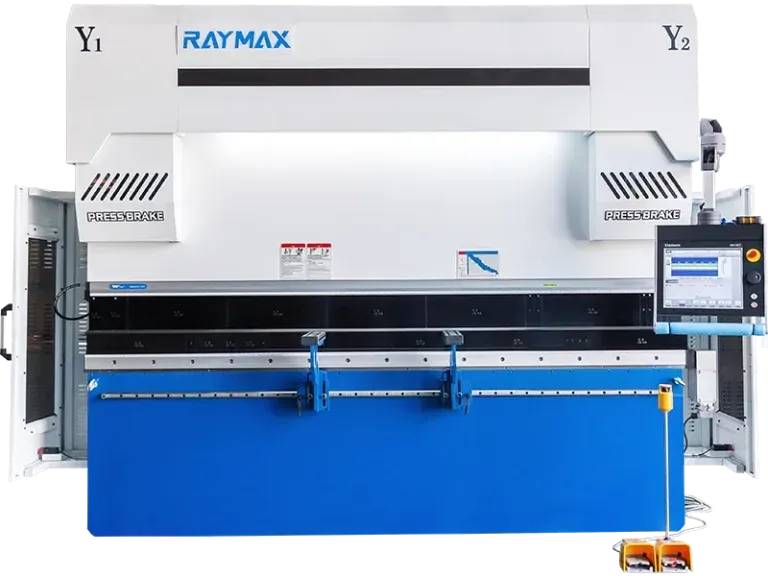
2. How a CNC Press Brake Works
Types of CNC Press Brakes
- Hydraulic Press Brakes: These use hydraulic cylinders to generate bending force. They are robust and capable of bending thick or hard materials but typically consume more energy and require hydraulic fluid maintenance.
- Electric (Servo-Driven) Press Brakes: These utilize electric servo motors to drive the ram. They offer high energy efficiency, faster cycle times, and quieter operation with precise control over position and speed.
- Hybrid Press Brakes: Combine hydraulic power with electric servo motors, offering the strength of hydraulics and efficiency of electric drives. These machines reduce energy consumption significantly while maintaining bending accuracy.
Main Components
- Frame and Ram (Upper Beam): The ram moves vertically, holding the punch that forms the bend by pressing the sheet into the die below.
- Bed (Lower Section): Fixed part of the machine holding the die. A crowning system is often included to compensate for frame deflection during bending, ensuring uniform bend angles across the sheet width.
- Back Gauge: A critical positioning device with multiple axes (commonly X, R, and Z), the back gauge precisely positions the sheet metal for accurate bends and allows programmable sequences for complex parts.

- CNC Controller: The control unit interprets the programmed bending sequence and controls the motion of the ram, back gauge, and other components. Modern controllers feature graphical interfaces and offline programming software.
- Drive Systems: Depending on the model, hydraulic pumps or electric servo motors power the movement of the ram and back gauge.
Bending Process
The metal sheet is placed between the punch (upper tool) and die (lower tool). The CNC system calculates the exact ram stroke, speed, and pressure needed to achieve the desired bend angle without overbending or springback. The back gauge moves to position the sheet correctly for each bend. This sequence is repeated for multi-bend parts, with the CNC system controlling each step precisely.
3. Advantages of CNC Press Brakes
- High Precision and Repeatability: Digital controls maintain consistent bending angles and positions, achieving tolerance levels as tight as ±0.01 mm.
- Reduced Setup Time: Automated back gauge positioning and pre-stored programs drastically cut changeover times.
- Multi-Axis Control: Enables complex geometries and multi-step bends without manual repositioning.
- Material Versatility: Capable of working with various metals including steel, aluminum, copper, and alloys.
- Energy Efficiency: Especially in electric and hybrid models, energy consumption can be reduced by over 70% compared to traditional hydraulic machines.
- Des dispositifs de sécurité: CNC systems often integrate sensors and safety guards, including light curtains and pressure sensors, minimizing workplace accidents.
- Industry 4.0 Integration: Modern CNC press brakes support data connectivity for real-time monitoring, predictive maintenance, and integration with factory automation systems.
4. CNC vs. Traditional Press Brakes
Fonctionnalité | Presse plieuse CNC | Traditional Press Brake |
Setup Speed | Fast, programmable | Slow, manual adjustments |
Precision | High (±0.01 mm) | Operator skill-dependent |
Repeatability | Very high | Variable |
Complexity of Bends | Multi-axis programmable | Limited by manual repositioning |
Niveau de compétence de l'opérateur | Moderate, focused on programming | High, requires manual skill |
Energy Consumption | Low (electric/hybrid) | High (hydraulic only) |
The CNC system dramatically increases efficiency, lowers labor costs, and reduces human error.
5. Maintenance and Care for CNC Press Brakes
Proper maintenance is essential to ensure long-term performance and reduce downtime:
- Lubrification régulière: Keep guide rails, screws, and moving parts well lubricated to minimize wear.
- Hydraulic Fluid Checks: For hydraulic models, monitor and replace hydraulic oil regularly to prevent contamination and maintain pressure consistency.
- Back Gauge Calibration: Periodic calibration ensures positional accuracy.
- Inspection of Electrical Components: Check cables, connectors, and control units for damage or wear.
- Software Updates: Keep the CNC controller software up to date to benefit from the latest features and bug fixes.
- Safety System Testing: Verify that sensors and emergency stops function correctly to comply with safety standards.
Following these practices will help maintain bending precision and extend machine life.
6. Why You Need a CNC Press Brake
Investing in a CNC press brake brings multiple benefits including:
- Improved Production Quality: Precise bending reduces defects and rework.
- Productivité accrue: Automation cuts cycle times and boosts throughput.
- Greater Flexibility: Easy to switch between different parts and jobs.
- Lower Operating Costs: Reduced energy use and less scrap material.
- Enhanced Worker Safety: Automated features and safety systems minimize risks.
Even small workshops can compete more effectively with CNC technology, while larger manufacturers can integrate press brakes into fully automated production lines.
7. About Raymax Bending
At Raymax Bending, we design and manufacture CNC press brakes tailored for today’s demanding manufacturing environments. Our machines combine rugged mechanical construction with the latest CNC control technology to deliver:
- Superior Accuracy with repeatability to ±0.01 mm, ensuring every bend meets specifications.
- User-Friendly CNC Interfaces with touchscreens and offline programming software to simplify operation.
- Flexible Drive Options including hydraulic, electric, and hybrid systems that suit different production needs and energy goals.
- Robust Frames engineered for maximum stiffness and minimal deformation under high pressure.
- Energy-Efficient Designs to reduce operating costs and environmental impact.
- Comprehensive Support and Service to keep your production running smoothly.
Explore our full line of CNC press brakes and discover how Raymax Bending can enhance your metal fabrication capabilities at raymaxbending.com/press-brake.