 Português
  English
  العربية
  Nederlands
  Français
  Deutsch
  Italiano
  Русский
  Español
Pressione freios are one of the most essential machines in the sheet metal industry, widely used in automotive, aerospace, construction, and general manufacturing. Their primary function is bending sheet metal into precise angles and complex forms, enabling the production of everything from car body panels to industrial enclosures. To achieve this, press brakes must be designed with a combination of strength, precision, and efficiency. At the heart of their performance lie the individual components that make up the machine. Understanding these key components is vital not only for machine builders but also for buyers, operators, and maintenance teams.
In this article, we will explore the most critical components in modern press brake manufacturing, analyze their functions, and explain how each part contributes to bending accuracy, productivity, and durability.
1. Frame Structure
The frame is the structural foundation of a press brake. Typically constructed from welded steel plates or cast iron, it provides rigidity and stability during the bending process. A poorly designed frame can result in vibrations, deflection, and loss of accuracy.
- Welded steel frames: are the most common in modern press brakes due to their cost efficiency and strength. Heat treatment is often applied after welding to relieve stress.
- Cast iron frames: while less common today, offer high damping capacity and stability.
The frame’s rigidity directly impacts bending precision, as even small deflections can affect the final angle of the workpiece.
The geometry of the frame is carefully engineered to withstand tons of force during operation, ensuring long-term reliability.
2. Hydraulic System
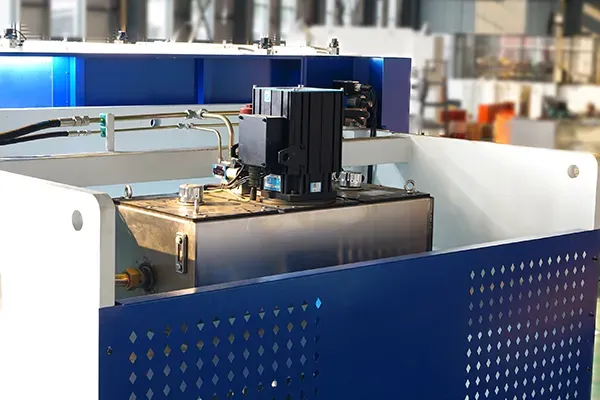
Hydraulics provide the muscle behind most traditional press brakes. The system includes hydraulic cylinders, pumps, valves, and oil reservoirs.
- Cylinders: convert hydraulic pressure into linear force, driving the ram downward to bend metal.
- Valves and pumps: regulate oil flow, ensuring precise movement and consistent force application.
- Pressure control: allows operators to fine-tune bending force depending on material thickness and type.
Maintenance of hydraulic systems is crucial—oil quality, filtration, and temperature management directly influence machine performance and lifespan. A malfunctioning hydraulic system can cause uneven bending or even complete machine failure.
3. CNC Control System
One of the most significant advancements in press brake manufacturing has been the adoption of Computer Numerical Control (CNC) systems.
- Programming and automation: Operators can input bend sequences, angles, and dimensions directly into the system, which then controls all movements automatically.
- Angle compensation: CNC systems calculate springback and apply corrections in real time.
- User-friendly HMI (Human Machine Interface): Modern touchscreens simplify programming and reduce setup time.
- Integration with CAD/CAM software: This allows seamless transfer of design files into production, reducing human error.
CNC technology transforms press brakes from manual machines into intelligent bending solutions, increasing productivity and reducing reliance on operator skill.

4. Tooling
Tooling is where the press brake meets the workpiece. Punches and dies define the shape of the bend and significantly influence the accuracy of the final product.
- Socos (upper tools) press the sheet metal into the die.
- Morre (lower tools) hold the sheet and provide the bending cavity. Common die types include V-dies, U-dies, and gooseneck dies for special shapes.
- Material selection: High-quality tool steel or carbide enhances durability, while coatings such as nitriding extend tool life.
The choice of tooling determines bend angle, radius, and part geometry. For manufacturers requiring frequent changeovers, quick-change tooling systems improve efficiency.

5. Backgauge System
O backgauge is a positioning system that ensures sheet metal is placed correctly before each bend.
- Função: It sets the distance between the edge of the workpiece and the bend line, ensuring consistency across multiple parts.
- Drive systems: Modern backgauges use servo motors, ball screws, and linear guides for high precision.
- Multi-axis backgauges: Advanced machines feature up to six or more axes, enabling complex bend sequences and minimizing manual adjustments.
Without a precise backgauge system, even the best tooling and CNC control cannot achieve consistent results.

6. Drive Mechanism
Press brakes can be categorized based on their drive mechanism:
- Mechanical press brakes: Once dominant, now largely obsolete due to limited control.
- Hydraulic press brakes: Widely used, offering high force and reliable operation.
- Electric servo press brakes: The most modern type, using servo motors for efficiency, precision, and energy savings.
Servo-electric systems are increasingly popular because they reduce power consumption, operate quietly, and require less maintenance. However, they are often more expensive upfront.
RAYMAX Press Brake
For companies seeking a reliable partner in press brake manufacturing, RAYMAX stands out as a trusted Chinese supplier. With a strong focus on innovation, RAYMAX integrates advanced CNC systems, high-precision tooling, and energy-efficient drive mechanisms into their machines. Their product line covers hydraulic, hybrid, and servo-electric press brakes, offering solutions tailored to different industries and production needs.
By combining robust engineering with user-friendly design and comprehensive after-sales service, RAYMAX ensures that manufacturers can achieve superior bending performance while maintaining cost efficiency. For businesses looking to invest in modern press brakes, RAYMAX provides an excellent balance of quality, innovation, and value.
Conclusão
Press brake manufacturing is a highly technical field where every component plays a critical role in performance, precision, and durability. The frame provides strength, the hydraulic or servo system delivers power, the CNC controller ensures accuracy, and tooling defines the final geometry. Accessories such as safety systems, lubrication, and IoT integration further enhance reliability and efficiency.
For manufacturers, choosing the right machine means evaluating each of these components carefully. High-quality parts not only ensure bending accuracy but also maximize long-term return on investment.