 Español
  English
  العربية
  Nederlands
  Français
  Deutsch
  Italiano
  Português
  Русский
When it comes to precision metal bending, the number of controlled axes in a CNC press brake plays a decisive role in the machine’s flexibility, speed, and complexity of parts it can handle. From 3 axis models ideal for simple tasks to advanced 8 axis machines suited for high-end industrial production, understanding the differences is critical when choosing the right machine for your business.
In this guide, we’ll explore the functions of 3 axis, 4 axis, 6 axis, and 8 axis press brakes and help you determine which one fits your metal fabrication needs best. If you’re searching for durable and high-performance options, RAYMAX offers a full range of CNC press brakes tailored to your production scale and complexity.
What Does "Axis" Mean in a CNC Press Brake?
Each axis in a CNC press brake refers to a direction or function that the machine can automatically control. Common axis designations include:
- Y1 and Y2: Control the movement of the ram (top beam) for synchronized and precise downward pressure.
- X axis: Moves the backgauge forward and backward to position the workpiece.
- R axis: Controls the vertical height of the backgauge.
- Z1 and Z2 axes: Adjust the lateral position of the backgauge fingers for asymmetrical or multi-bend operations.
More advanced press brakes may include crowning control, automatic angle measurement systems, and dual R-axis movement.
3 Axis Press Brake: Basic but Effective
A 3 axis press brake typically controls Y1, Y2, and X axes. This configuration is ideal for:
- Simple, straight bending operations
- Low-to-moderate production volume
- Small fabrication shops or job shops

Pros:
- Cost-effective
- Easier to operate
- Great for flat parts with uniform bends
Limitations:
- No vertical (R-axis) or lateral (Z-axis) gauge movement
- Not suitable for complex parts with variable angles or multiple flanges
RAYMAX offers robust 3-axis CNC press brakes that are ideal for small-to-medium size businesses looking for affordable bending solutions with essential accuracy.
4 Axis Press Brake: A Step Toward Versatility
A 4 axis press brake adds the R axis for vertical backgauge movement. This enables greater flexibility for parts with multiple bends at varying heights.
Ideal for:
- Medium complexity jobs
- Repetitive multi-bend parts
- Increased setup speed
By upgrading to a 4-axis press brake, fabricators can achieve better control over flange positioning, improving both accuracy and productivity.
6 Axis Press Brake: For Precision and Speed
With the inclusion of Z1 and Z2 axis, a Prensa plegadora de 6 ejes enables lateral positioning of the backgauge fingers. This is essential when working with asymmetrical or complex bend sequences.
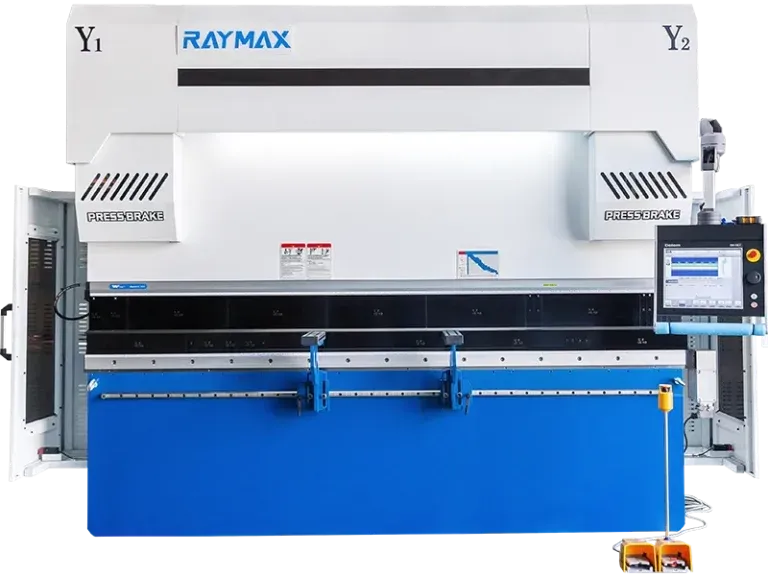
Características:
- X, R, Z1, Z2 + Y1, Y2 axes
- Automatic positioning for complex part geometries
- Faster setup for varying jobs
RAYMAX 6-axis CNC press brakes are designed for high-efficiency production environments, particularly for industries such as furniture, enclosures, and HVAC systems, where repeatable accuracy and fast changeovers are essential.
8 Axis Press Brake: Full Automation and Advanced Control
An 8 axis press brake typically includes all of the above plus:
- Dual R-axis (R1 and R2)
- Advanced crowning systems
- Option for angle sensors and real-time feedback

Perfect for:
- Complex parts with multiple bends in varying planes
- High-volume production
- Robotic integration and automation
If your business manufactures aerospace parts, electrical enclosures, or high-precision components, investing in an 8 axis CNC press brake from RAYMAX will future-proof your production line and support full digital control.
How to Choose the Right Configuration for Your Needs
When selecting the best CNC press brake, consider these key factors:
Factor | Recommended Axis Range |
Simple bends, low volume | 3 Axis |
Multi-height flanges | 4 Axis |
Complex parts, moderate volume | 6 Axis |
Complex + high volume + automation | 8 Axis |
Other important considerations:
- Tipo de material: Thicker or stronger materials may benefit from more precise backgauge control.
- Nivel de destreza del operador: More advanced machines require higher training but deliver greater performance.
- Future Scalability: Choose a configuration that accommodates projected business growth.
Cost vs Capability: When Is It Worth Upgrading?
While a 3 or 4 axis machine may suffice today, investing in higher-axis configurations may save time and labor in the long run. For example, a 6 or 8 axis press brake can reduce changeover time, lower rejection rates, and integrate into automated production lines.
RAYMAX engineers are available to help you assess your production flow and recommend a tailored solution—ensuring you only invest in what truly adds value to your operation.
Let Your Parts Define Your Press Brake
For high-quality, CNC-controlled press brakes across all axis configurations, explore the full range at RAYMAX Press Brake. Whether you’re looking to upgrade an outdated machine or launch a new production line, our expert team will help you choose the best-fit solution for your shop.